
Fines and Expiation Notices

Should I Pay My Traffic Fine? Your Options Before Paying an Expiation Notice in SA
Maybe. But before you pay a traffic fine, make sure you understand what paying it means.
For many traffic offences, the amount of the fine is not the most important consequence. Paying an expiation notice can also result in demerit points being recorded against you. Those points can affect your licence for three years from the date of the offence.
If there is a proper basis to challenge the allegation, or to ask a Court to reduce or eliminate the demerit points, paying the fine may mean giving up that opportunity.
That can be important even if this particular fine will not cause you to lose your licence.
If driving is important to your work, your family responsibilities or your independence, it is worth understanding all of your options before deciding simply to pay the fine.
What is an expiation notice?
An expiation notice is what most people simply call a “traffic fine”.
Rather than prosecuting you in Court for certain traffic offences, an expiation notice gives you the opportunity to deal with the alleged offence by paying the amount specified in the notice.
Common examples include fines for:
- speeding;
- using a mobile phone while driving;
- failing to stop at a red light or stop sign;
- failing to wear a seatbelt; and
- other road traffic offences.
Camera-detected offences can also result in an expiation notice being sent to the registered owner of the vehicle.
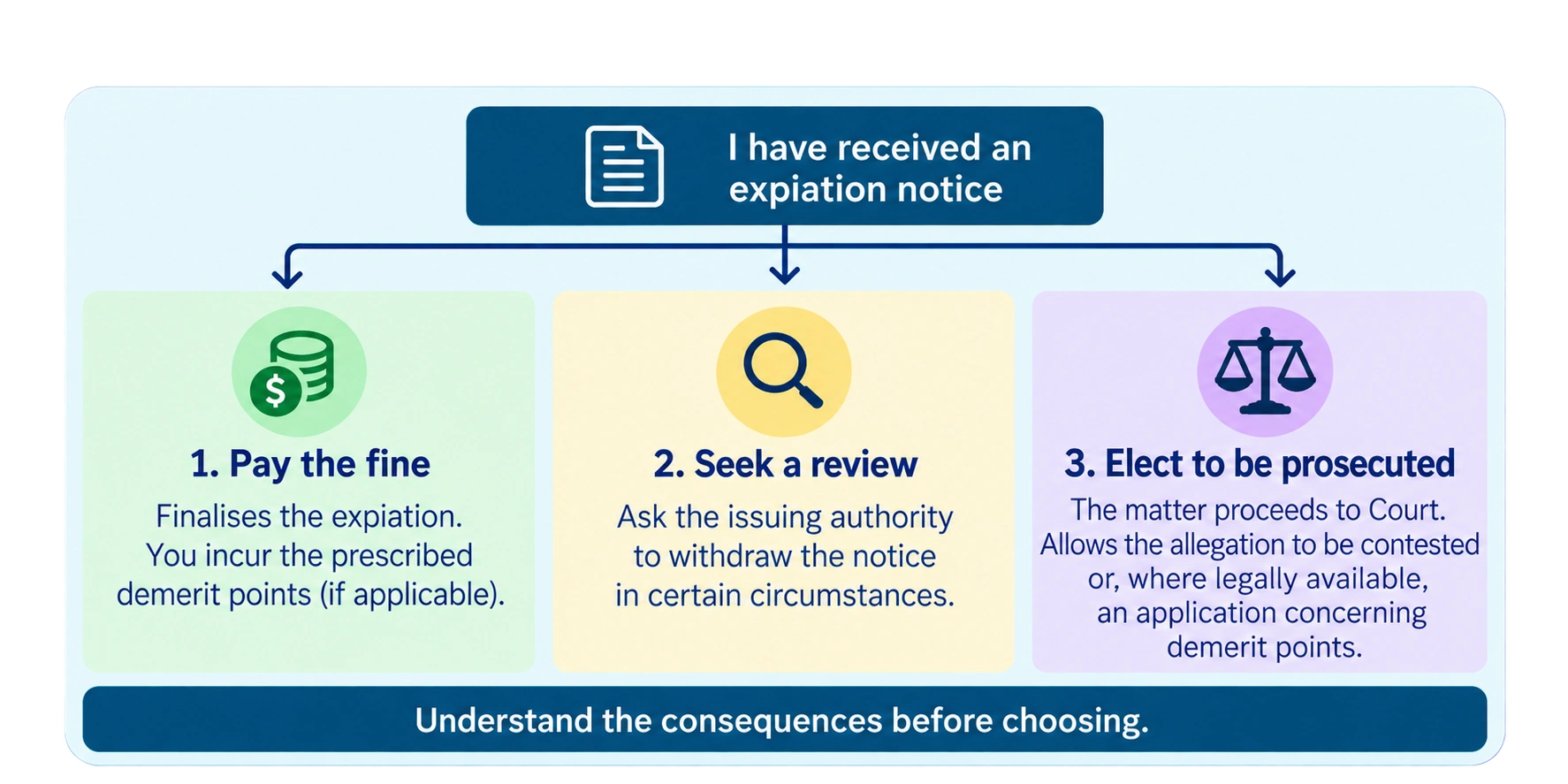
An expiation notice does not mean that your only option is to pay it. Depending upon the circumstances, you may be able to seek a review, nominate the actual driver in the case of some camera offences, or elect to be prosecuted so that the matter is dealt with by a Court.
What happens if I pay my traffic fine?
Paying the expiation notice finalises the offence without the need to go to Court.
But if the offence carries demerit points, paying the fine also means that the prescribed demerit points will be recorded against you.
This is important because once the expiation has been paid, you cannot simply decide later that you would prefer to challenge the allegation or ask a Magistrate to reduce the demerit points.
Before paying, you should therefore know:
- how many demerit points the offence carries;
- how many points you have already accumulated;
- whether there is any proper basis to dispute the allegation;
- whether the circumstances of the offence might justify an application for fewer or no demerit points; and
- how important your driver’s licence is likely to be to you over the next three years.
How do demerit points work in South Australia?
A common misconception is that drivers start with a number of points and gradually “lose” them.
It is actually the other way around.
You start with zero demerit points and incur points when you commit offences that attract them.
For a driver holding an ordinary full licence, accumulating 12 or more demerit points for offences committed within a three-year period can result in disqualification.
The number of points depends upon the offence. For example, speeding offences can attract between 2 and 9 demerit points depending upon the speed involved, while offences such as using a mobile phone while driving and failing to stop at a red traffic light ordinarily attract 3 points.
Different rules and thresholds apply to learner and provisional drivers.
When do demerit points start and how long do they last?
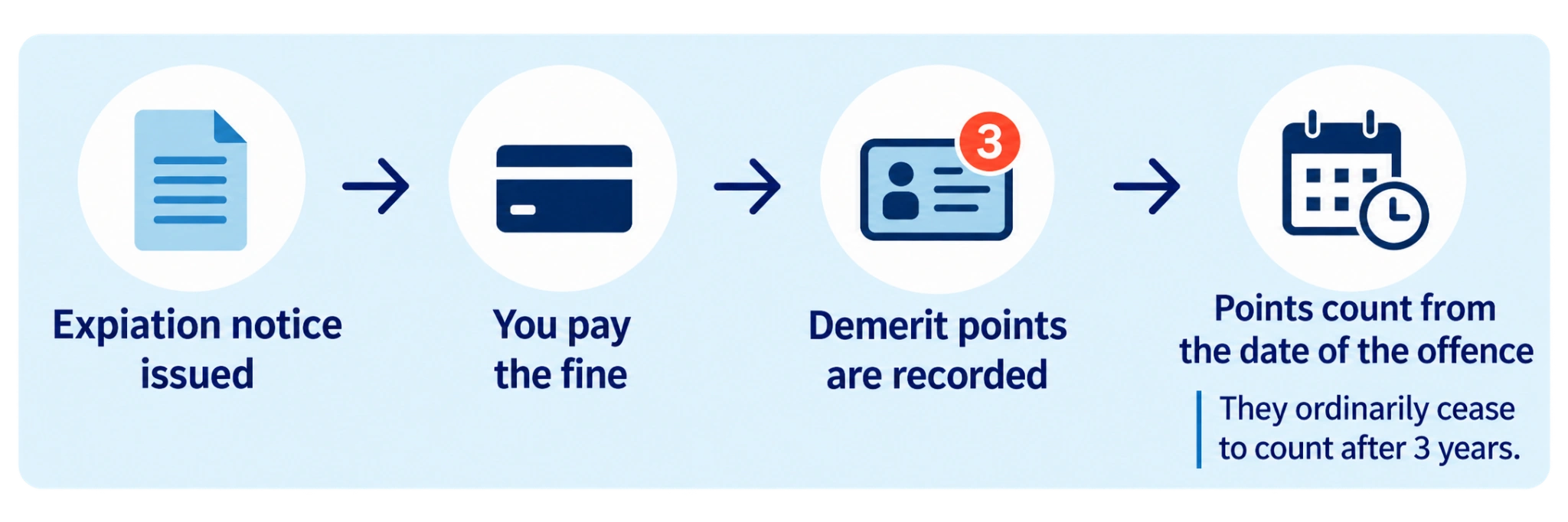
Demerit points apply from the date of the offence, not the date on which you pay the fine.
They are recorded once the expiation is paid or the matter is finalised in Court, but for the purpose of calculating your demerit-point position they relate back to the offence date.
Ordinarily, they cease to count three years after the date of the offence.
That three-year period is one reason why it can be a mistake to consider a traffic fine in isolation.

My licence isn’t at risk. Why shouldn’t I just pay the fine?
You may decide that paying it is the sensible option.
But the fact that this particular fine will not result in the loss of your licence does not necessarily mean that the demerit points do not matter.
Suppose you receive an expiation notice carrying three demerit points. You have an arguable defence, or the circumstances might provide a proper basis to ask a Court to reduce the points. But you currently have very few demerit points, so you decide it is easier simply to pay the fine.
Eighteen months later, you commit another traffic offence.
This time there is no defence and nothing unusual about the circumstances of the offence. The three points you accepted 18 months earlier may now make the difference between keeping and losing your licence.
You generally cannot go back and challenge the earlier offence simply because those points have now become important.
If your licence matters to you, the time to consider protecting it is not necessarily when you are about to lose it.
Can SAPOL reduce the demerit points on my fine?
No.
The number of demerit points applying to an expiated offence is prescribed by law. Police do not have a general power to decide that, for example, a three-point offence should carry only one point because of your circumstances or because you need your licence.
This is an important distinction between asking for a review of an expiation notice and asking a Court to reduce the demerit points.
They are not the same thing.
Can I ask for my traffic fine to be reviewed?
Yes. There is a process for seeking a review of an expiation notice.
For a SAPOL notice, a review may be sought where it is claimed that:
- the offence was “trifling”;
- the notice is incorrect or a mistake has been made; or
- there are other exceptional circumstances.
An offence may be considered trifling in circumstances such as where there were compelling humanitarian or safety reasons for the conduct, the offence could not reasonably have been avoided, or the conduct was merely a technical, trivial or petty breach.
A review is an administrative process conducted by the issuing authority. It is not a Court hearing.
That distinction is important.
If you want to contest the allegation and have a Magistrate determine whether the offence has been proved, the process is to elect to be prosecuted.
Should I ask for a review before electing to go to Court?
That depends upon the circumstances.
A review can be appropriate where there is a clear mistake or where the particular circumstances fall within the grounds upon which the issuing authority can withdraw the notice.
But seeking a review may involve making an admission or concession about what occurred, particularly if you are submitting that the offence was trifling. That could affect your ability to contest the charge later if you genuinely dispute committing the offence. The point is not that you should avoid making admissions so that you can later give a different account; rather, you should understand whether the position you put forward for review concedes something that you genuinely dispute.
A review and a Court proceeding are fundamentally different processes.
In a review, the issuing authority decides whether the notice should continue.
If you elect to be prosecuted, the allegation ultimately becomes a matter for a Court.
The appropriate course depends upon why you say the notice should not stand and what outcome you are trying to achieve.
Different Court consequences can apply. Get advice before electing.
Can I challenge a traffic fine in Court?
Yes.
A person who has received an expiation notice can generally elect to be prosecuted for the alleged offence rather than expiating it.
This is sometimes described as “taking the fine to Court”, although technically you are electing to be prosecuted for the offence alleged in the notice.
Once that occurs, the expiation notice is withdrawn in relation to that offence and the matter proceeds through the Court system.
Does electing to be prosecuted mean I have to plead not guilty?
No.
This is an important point.
There can be two quite different reasons for electing to be prosecuted.
You might say:
“I did not commit the offence.”
In that case, you may plead not guilty and require the prosecution to prove the charge.
Alternatively, you might accept that the offence occurred but want the Court to consider whether the usual number of demerit points should apply.
In that situation, it may be possible to plead guilty while making an application concerning the demerit points.
The appropriate course depends upon the facts of the case.
Can a Magistrate reduce my demerit points?
Yes, in appropriate circumstances.
Section 98B(4) of the Motor Vehicles Act 1959 (SA) forms part of South Australia’s demerit-point scheme.
It provides that, where a person is convicted of an offence, the Court may order that a reduced number of demerit points—or no demerit points—are incurred if the Court is satisfied by evidence given on oath that:
- the offence was trifling; or
- any other proper cause exists.
Those expressions have legal meanings. It is not simply a general discretion allowing a Magistrate to reduce points whenever the result seems harsh.
Whether an application has reasonable prospects depends upon the particular circumstances, and that is why obtaining advice from an experienced traffic lawyer is important.
Can I just pay the fine but challenge the demerit points?
Generally, no.
If you pay an expiation notice for an offence carrying demerit points, the prescribed points follow from the expiation.
You cannot simply pay the monetary penalty and separately ask a Magistrate to reduce the points.
If you want a Court to consider reducing the demerit points under section 98B(4), the matter needs to come before the Court. That ordinarily requires an election to be prosecuted before the expiation is finalised.
This is one of the most important things to understand before paying a traffic fine.
I need my licence for work. Can the Court reduce my points because of that?
The fact that you need your licence for work does not, by itself, mean that your demerit points can be reduced.
This often comes as a surprise.
Losing a licence can have very serious consequences. A tradesperson may be unable to travel between jobs. A salesperson may spend most of the working day on the road. A shift worker may have no practical public transport available. A business owner may depend upon driving to operate the business.
Those consequences can be extremely important to the person involved.
But an application under section 98B(4) is not simply an application asking a Magistrate to let you keep your licence because losing it would cause hardship.
That is another reason why people who depend upon driving should consider their demerit-point position before paying each expiation notice.
Can I get a “work licence” in South Australia?
There is no general “work licence” in South Australia that allows you to continue driving simply because you need your driver’s licence for your employment.
In particular, a person facing a demerit-point disqualification cannot simply apply to a Court for permission to drive to and from work because losing their licence would cost them their job.
People sometimes hear about “work licences” available elsewhere or assume that a Magistrate can impose a restricted licence allowing driving during certain hours.
That is not how the South Australian demerit-point system operates.
There may, however, be a Good Behaviour Option available to some drivers who have accumulated enough demerit points to be disqualified. That is a different thing altogether.
What is the Good Behaviour Option?
If you hold a current full driver’s licence and receive a demerit-point disqualification notice, you may be eligible to elect a 12-month Good Behaviour Option instead of serving the disqualification.
If eligible and you elect the option in time, you can continue driving.
But there is a significant condition: you must not incur 2 or more demerit points during the 12-month good behaviour period.
If you do, you can be disqualified for twice the period of the original disqualification, without another Good Behaviour Option.
A Good Behaviour Option is therefore not a “work licence”. It is a statutory alternative to serving an eligible demerit-point disqualification and should be understood carefully before it is elected.

What if someone else was driving my car?
This is particularly relevant to camera-detected offences.
Camera expiation notices are ordinarily issued to the registered owner of the vehicle. If another person was actually driving, there is a process for nominating the driver.
You should not simply pay the fine if you were not the driver.
If the registered owner pays a camera expiation, the associated demerit points can be recorded against that person.
What if I think the traffic camera is wrong?
Do not assume that photographic or camera evidence is incapable of being challenged.
The appropriate first step will depend upon the type of offence and the issue with the evidence.
For camera offences, it may be possible to view the photograph before deciding what to do.
Mobile-phone detection offences in particular can raise questions about what the image actually establishes and whether the prosecution can prove all of the elements of the alleged offence.

Can I see the evidence before deciding what to do?
Sometimes.
For a camera offence, photographic evidence may be available to view.
However, the evidence available through an administrative review process is not necessarily the same as the material that may become available through the Court process after an election to be prosecuted.
If your decision depends upon a particular evidentiary issue, it can therefore be worthwhile obtaining advice about the nature of the evidence and the appropriate procedure before deciding what to do with the expiation notice.
Is it worth fighting a traffic fine?
There is no single answer.
For some people, paying the fine will be the quickest, cheapest and most sensible way of dealing with it.
For others, the amount printed on the notice is not the real issue.
The more important questions may be:
- Do I actually have a defence?
- How many demerit points will I incur?
- What is my existing demerit-point position?
- Do the circumstances provide a proper basis for seeking fewer or no points?
- How important is my licence to my employment or everyday life?
- What will these points mean if I commit another offence during the next three years?
- What will it cost to take the matter to Court?
- What are the risks if I am unsuccessful?
- Could the offence carry a mandatory licence disqualification if I am convicted in Court?
A $500 or $600 fine may be inconvenient. Losing the ability to drive can be far more significant.
Equally, Court proceedings involve cost and risk and should not be commenced without understanding those consequences.
The decision should be based upon the whole picture, not simply the amount of the fine.
What happens if I elect to be prosecuted?
Once a valid election is made, the expiation notice is withdrawn in relation to the relevant offence.
The matter can then proceed by prosecution and you may receive a summons requiring you to attend Court.
Depending upon the circumstances, you may:
- plead not guilty and contest the charge;
- plead guilty;
- obtain and consider prosecution evidence;
- make appropriate representations to the prosecution; or
- if legally available, ask the Court to reduce or eliminate the demerit points.
Electing to be prosecuted is an important decision. You generally cannot simply change your mind afterwards and ask to have the original expiation notice reinstated.
What are the risks of taking a traffic fine to Court?
There can be good reasons for electing to be prosecuted. You may genuinely dispute committing the offence, want the prosecution evidence tested, or need the matter to come before a Court so that you can make an application concerning demerit points.
But an election to be prosecuted is not risk-free.
You could end up financially worse off. If you are convicted, the Court can impose a fine as well as levies, Court fees, prosecution costs and, in some circumstances, other costs.
In our experience, however, the financial outcome is not always as simple as adding Court costs to the amount that appeared on the expiation notice. Where there was a legitimate reason for bringing the matter before the Court - including an appropriate application concerning demerit points - Magistrates will often take the additional costs into account when determining the overall penalty. Court costs may also be waived in appropriate cases.
That cannot be guaranteed. The Court determines the penalty and costs in each individual case.
There is also a risk that a conviction will be recorded. Paying an expiation notice does not ordinarily result in a conviction being recorded. If you elect to be prosecuted and are found guilty, the matter is instead dealt with by a Court and a conviction may be recorded.
A conviction is not inevitable merely because you elect to be prosecuted and plead guilty. Whether a conviction is recorded depends upon the applicable sentencing law and the circumstances of the case. However, it is a consequence that should be considered before electing.
For some offences, being convicted in Court can also result in a mandatory period of licence disqualification that would not necessarily arise if the matter were dealt with by expiation.
For example, the Road Traffic Act 1961 (SA) requires a Court to impose a minimum period of disqualification following conviction for certain offences, including:
- a first Category 1 prescribed concentration of alcohol offence, where the minimum disqualification is 3 months;
- a first offence under section 47BA, where the minimum disqualification is 6 months; and
- a first offence under section 45C, where the minimum disqualification is 6 months.
That can be particularly important if you are considering electing to be prosecuted primarily so that you can ask the Court to reduce or eliminate demerit points.
An election intended to protect your licence can therefore, for some offences, expose you to a different and potentially more serious licence consequence.
Before electing to be prosecuted, you should understand both what you might gain by going to Court and what penalties the particular offence can attract once it is dealt with by a Court. This is an area where advice from an experienced traffic lawyer is particularly important.
What if I just ignore the traffic fine?
Ignoring an expiation notice does not make it disappear.
If it is not dealt with within the required time, additional fees and enforcement processes can follow. Importantly, allowing the matter to progress too far can also affect your ability to elect to be prosecuted.
If you want to challenge an expiation notice, simply not paying it is not the way to do that.
What if the offence carries an immediate or automatic loss of licence?
Some traffic offences can have consequences beyond an ordinary fine and demerit points. Depending upon the offence, you may also receive an Immediate Loss of Licence notice or face another form of licence disqualification.
That raises different legal issues and different procedures.
If you have received an Immediate Loss of Licence notice, do not assume that deciding whether to pay the accompanying expiation notice deals with the licence disqualification as well.
Read more: Immediate Loss of Licence in South Australia – Can I Challenge It?
So, should I pay my traffic fine?
For many people, the answer will be yes.
If you committed the offence, there is no proper basis for challenging it or seeking a different demerit-point outcome, and you understand the effect of the points, paying the expiation notice may be the simplest and most economical option.
But make that decision before you pay, not afterwards.
In particular, think carefully before paying if:
- you dispute committing the offence;
- you believe the notice or photographic evidence may be wrong;
- there were unusual circumstances surrounding the offence;
- you already have demerit points;
- the new points could result in disqualification;
- you are on a Good Behaviour Option;
- you hold a learner’s permit or provisional licence;
- driving is important to your employment, business, caring responsibilities or independence; or
- you simply do not understand what consequences will follow from paying the notice.
When should I speak to a traffic lawyer?
Ideally, before paying the expiation notice, entering into a payment arrangement or electing to be prosecuted.
A traffic lawyer can advise you whether there is any realistic basis to:
- challenge the alleged offence;
- seek withdrawal of the notice;
- elect to be prosecuted;
- defend the charge in Court; or
- seek a reduction or elimination of demerit points under section 98B(4).
Just as importantly, a lawyer can tell you when there is no sensible reason to take the matter further.
The purpose of obtaining advice is not necessarily to fight the fine. It is to make an informed decision before choosing a course that may be difficult or impossible to undo.
Legislation Referred To:
• Motor Vehicles Act 1959 (SA) - Part 3B, particularly s 98B(4) (Court power concerning demerit points).
• Road Traffic Act 1961 (SA) - s 47B(3)(a)(i) (mandatory disqualification following relevant conviction, including first Category 1 offence).
• Road Traffic Act 1961 (SA) - s 47BA(4)(a)(i) (mandatory disqualification following first conviction under s 47BA).
• Road Traffic Act 1961 (SA) - s 45C(3)(a)(i) (mandatory disqualification following first conviction under s 45C).