

Can Workers Compensation Still Cover Problems From an Injury 20 Years Ago?
June 2, 2026
Many workers assume that once enough time has passed after an old workplace injury, any future problems are simply part of “getting older”.
A sore knee becomes arthritis. A bad back becomes degeneration. Pain that once came and went becomes constant.
And often the assumption is:
“It happened too long ago – surely Workers Compensation won’t cover this now.”
A recent decision of the South Australian Employment Tribunal (SAET), involving a worker seeking approval for a knee replacement more than 20 years after his original workplace injury, challenges that assumption.
The case is particularly important for older workers and people who have had a workers compensation claim years ago but are now experiencing worsening symptoms, arthritis or the need for surgery.
Because, as the Tribunal ultimately found:
just because time has passed, or ageing has caught up, does not necessarily mean a work injury stops mattering.
Can An Old Work Injury Still Be Compensable?
The short answer is:
Yes — sometimes, even decades later.
That was exactly the issue in this case.
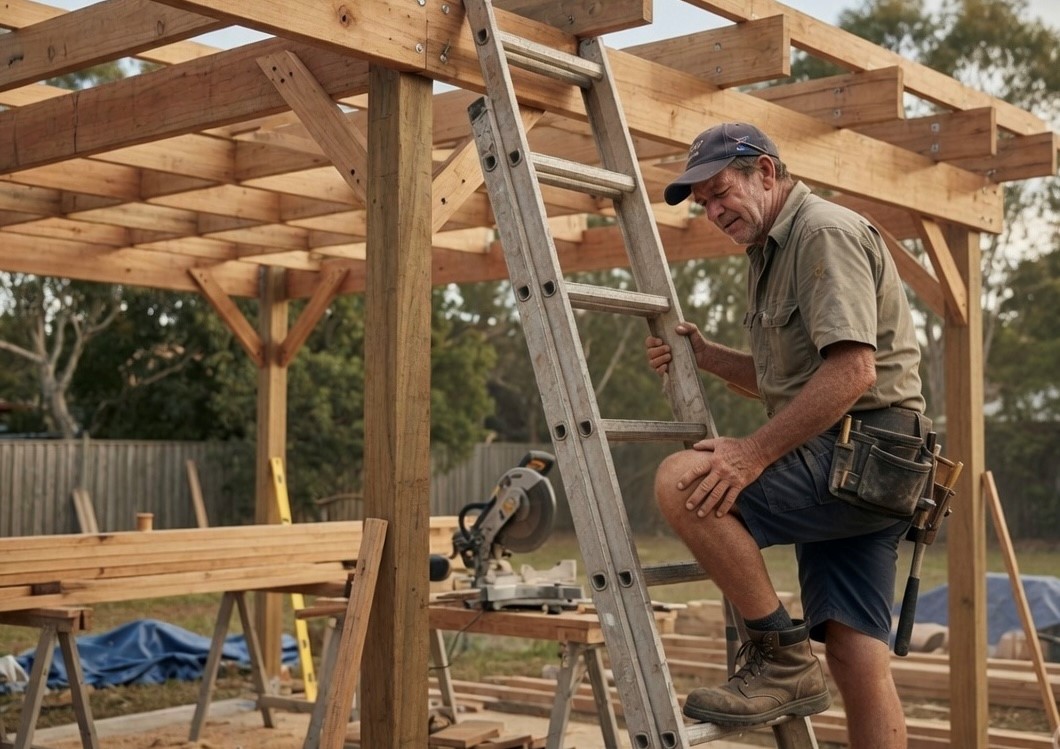
The worker had injured his knee in 2002 while working as a construction carpenter. He struck his knee on timber while building a pergola, causing swelling and pain. Investigations later confirmed a meniscal tear and he underwent surgery shortly afterwards. A workers compensation claim was accepted and, after undergoing surgery, in due time he returned to work.
He continued in physically demanding jobs for years. However, the evidence showed that although his symptoms improved after surgery, they never completely resolved. He continued experiencing pain, instability and aching in the injured knee over many years, particularly after physically demanding work.
Fast forward more than two decades.
By 2024, the worker, then aged 60, required a total knee replacement.
But Return to Work Corporation refused to approve the surgery.
Why?
Because it argued that what the worker was now experiencing was no longer really about the original injury.
Instead, it said the need for surgery was simply the result of natural ageing and degeneration.
What If Return to Work Says It Is “Just Ageing”?
By the time the worker sought approval for surgery, scans showed that both knees had severe arthritis.
The problem for the worker was this:
His right knee, which had never been injured at work, had now deteriorated to a very similar extent as his injured left knee.
The Return to Work Corporation argued that this was important.
It said that because both knees now looked equally degenerated, the worker’s need for surgery was simply the natural progression of arthritis that would have happened anyway as part of the ageing process.
In other words:
“This is now just age-related wear and tear.”
Many workers hear similar arguments.
Particularly older workers, or those with physically demanding jobs, are often told that arthritis, worn joints or deterioration are simply part of getting older.
The Tribunal, however, looked more closely at the bigger picture.
What If the Original Injury Made Things Worse Earlier?
One of the most important features of the case was the medical evidence showing that the worker’s injured knee had deteriorated earlier and differently than the uninjured knee.
When scans were performed in 2011, the worker’s left knee, the one injured at work, showed substantially worse degenerative change than the right knee. At that stage, the deterioration was asymmetrical.
The Tribunal accepted that the original work injury and subsequent surgery had accelerated the development of osteoarthritis in the left knee.
By 2017, the worker’s injured knee had reached the point of being described as effectively “bone-on-bone”, and surgery had already been discussed with his treating surgeon.
Because while the worker’s right knee eventually “caught up” over time, the Tribunal accepted that the work injury had materially contributed to the worsening of the left knee long before that occurred.
What If You Delayed Surgery for Years?
The worker gave evidence that his surgeon had effectively told him he was “too young” for a knee replacement in 2017 and advised him to delay surgery for as long as possible because artificial joints have a limited lifespan.
So he did what many workers do:
He pushed through and kept working.
He wore braces, managed the pain and delayed surgery for years while continuing employment.
The Tribunal accepted that evidence.
Importantly, it rejected the idea that delaying surgery somehow erased the connection between the original work injury and the need for treatment.
In a particularly practical observation, the Tribunal effectively noted that the worker should not lose his entitlement simply because he followed medical advice and delayed surgery for as long as possible.
Does Natural Ageing Automatically Stop a Workers Compensation Claim?
No.
And this is one of the key takeaways from the decision.
The Tribunal accepted that ageing, work history and natural degeneration all played some role in the worker’s condition.
However, that did not automatically mean the original work injury stopped being relevant.
Instead, the Tribunal looked at the overall history:
- the original workplace injury,
- the surgery,
- the fact symptoms never fully resolved,
- the earlier deterioration in the injured knee,
- the worker’s ongoing symptoms,
- and the medical evidence showing the injury accelerated the degenerative process.
The Tribunal ultimately found there remained a sufficient connection between the original work injury and the need for surgery more than 20 years later, and the worker’s claim succeeded.
Why This Case Matters for Older Workers
Many people continue working despite arthritis, old sporting injuries, previous surgeries, worn joints and physically demanding jobs. Over time, symptoms often worsen. Over time, symptoms often worsen.
People frequently assume:
“I’m older now — surely it’s just degeneration.”
Or:
“The original injury happened years ago, so there’s nothing I can do.”
This case demonstrates that those assumptions are not always correct.
Even where ageing and degeneration are involved, a worker may still have an entitlement if an earlier work injury materially contributed to the condition or accelerated the need for treatment.
Have an Old Work Injury That Is Getting Worse?
At Websters Lawyers, we regularly assist workers in disputes involving:
- worsening symptoms from old injuries,
- arthritis and degenerative conditions,
- delayed surgery approvals,
- disputes about causation,
- and claims where employers or insurers argue the problem is “just ageing”.
We understand that many workers simply assume it is too late to do anything.
Often, that assumption is wrong.
If you suffered a work injury years ago and are now experiencing worsening symptoms or require treatment or surgery, it may be worth obtaining legal advice.
We offer a free initial telephone consultation to discuss your situation and your options.
Call 8231 1363 to speak with one of our experienced Workers Compensation lawyers.
Scott v Return to Work Corporation of South Australia [2026] SAET 52