

Court Sets Aside $40,000 Trespass Award Against Police — But Finds “No Bail” Arrest Warrant Was Malicious
May 21, 2026
In 2024, we reported on a Supreme Court decision in which South Australian police were ordered to pay a man $40,000 damages after officers repeatedly entered his property despite him revoking permission for police to do so.
That decision has now been overturned by the South Australian Court of Appeal. However, the appeal court still found that the man succeeded in an important part of his claim — namely that a police prosecutor improperly sought a “no bail” arrest warrant without reasonable and probable cause and for a malicious purpose.
The Court of Appeal found that the police prosecutor sought the warrant for the malicious purpose of punishing the man for being a “pain in the arse”.
While the appeal court ultimately set aside the earlier trespass damages award, the decision remains a significant reminder that courts will closely scrutinise the exercise of police powers, particularly where arrest warrants, detention and malicious prosecution are involved.
Can You Sue Police for Wrongful Arrest or Malicious Prosecution?
In some circumstances, yes.
Australian courts have long recognised that members of the public may be entitled to compensation where police powers are exercised unlawfully or improperly. Depending on the circumstances, claims can arise from wrongful arrest, unlawful detention, assault, malicious prosecution, trespass or other misuse of police powers.
That does not mean every unsuccessful prosecution or unpleasant interaction with police will justify legal action. Police officers are frequently required to make difficult decisions in dynamic and stressful situations, often with limited information available to them at the time.
However, courts will still intervene where powers are exercised without lawful justification or where legal processes are misused.
This case is a good example of how complex those claims can become.
What Was the Case About?
The case arose from events that occurred in 2015.
Police observed the man driving erratically before attempting to conduct an alcotest. The man refused to provide a breath sample and was arrested.
Importantly, however, a blood test later showed that his blood alcohol reading was only 0.011 — well below the legal limit.
The man was nevertheless charged with refusing to submit to an alcotest.
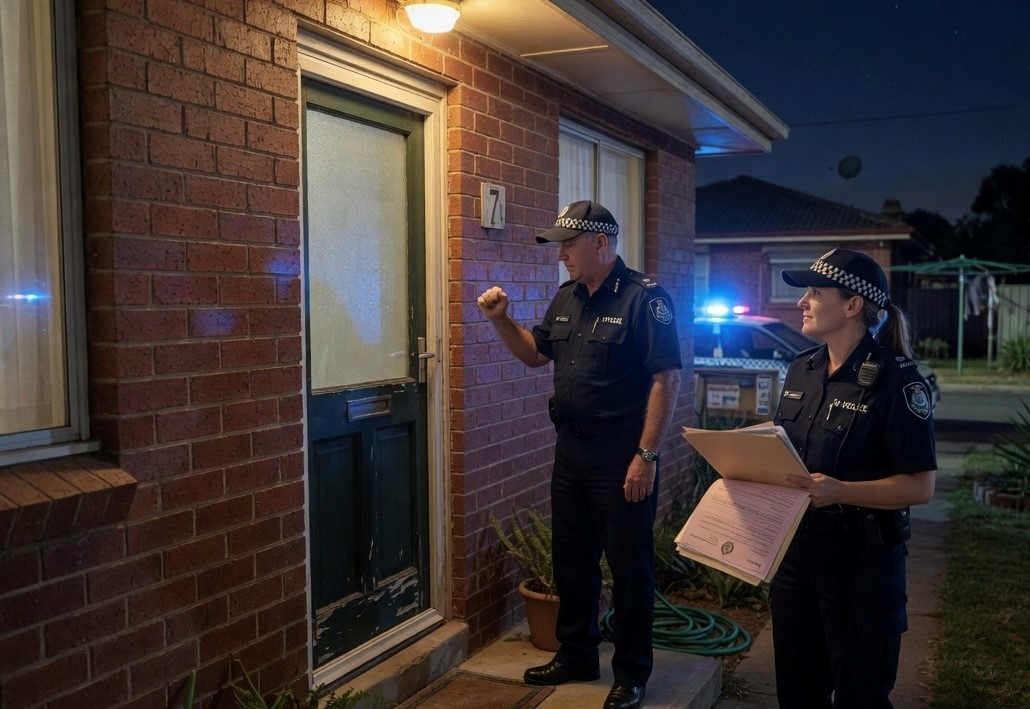
Police then attempted on several occasions to serve him with a summons at the property where he lived with his mother. Those attendances ultimately became the basis of the earlier trespass proceedings which we previously reported on.
Eventually, police prosecutors applied for an arrest warrant with a “no bail” endorsement.
That meant police would not have authority to release him on bail if he was arrested.
The warrant was executed after the man returned home from an overseas trip. He was arrested, taken into custody and held overnight before eventually being granted bail by the Magistrates Court the following day.
The charge against him was later withdrawn.
Why as the $40,000 Trespass Award Overturned?
The original trial judge had found that police officers trespassed by entering the property after the occupant had revoked any implied permission for police to attend there. Damages of $10,000 were awarded for each of four separate attendances.
However, the Court of Appeal overturned that finding.
The appeal court found that the man did not have sufficient legal possession of the property to personally maintain the trespass claim because the property belonged to and was occupied by his mother.
The Court also found that the signage at the property was inadequate to effectively communicate any revocation of permission for police to enter the premises.
Importantly, the Court further held that the police officers involved were not personally aware that any implied permission had supposedly been revoked.
For those reasons, the earlier trespass damages award was set aside.
What Is Malicious Prosecution?
Malicious prosecution is a relatively uncommon but serious legal claim.
Broadly speaking, it involves situations where legal proceedings are initiated or maintained without proper basis and for an improper purpose.
These claims are difficult to establish and require careful legal analysis. A person must usually prove more than simply the fact that charges were later withdrawn or dismissed.
This case demonstrates that courts are willing to closely examine police and prosecution conduct where arrest powers, detention and prosecution processes may have been improperly used.
Claims Against Police Can Be Complex
One of the most interesting aspects of this case is that the man succeeded in part, but failed in part.
The Court rejected a number of his claims, including the original trespass damages award. However, he still succeeded in establishing malicious prosecution relating to the “no bail” warrant.
That highlights an important point: claims against police are rarely straightforward.
Cases involving allegations of wrongful arrest, unlawful detention or malicious prosecution often involve multiple overlapping legal issues concerning police powers, arrest procedures, detention, prosecution decisions and questions of lawful authority.
Success or failure may ultimately depend on relatively narrow legal issues or the precise evidence available.
Need Advice About Police Conduct or Wrongful Arrest?
At Websters Lawyers, we regularly advise clients in matters involving police conduct, wrongful arrest, malicious prosecution, unlawful detention and claims for compensation against police or the State.
We understand that interactions with police can be stressful, confronting and legally complicated. If you believe you may have a claim arising from police conduct, it is important to obtain legal advice as early as possible.
We offer a confidential initial consultation to discuss your situation and advise you about your options.
Call 8231 1363 to speak with one of our lawyers.
Cosenza v State of South Australia [2026] SASCA 49